En sammankomst av något slag; nu ska vi förflytta oss. Jag kan inte vägen, vet inte ens riktigt var vi befinner oss mer än att det är någonstans längs Sveriges ostkust. Men den som kör mig, en av lokalbefolkningen, medelålders, talför, tar oss utan tvekan över ån längs en raksträcka som efter en rondell med gräll kommunal blomsterplantering försvinner in bland lövträd. Så, en gravgård.
Ordningsföljden är otydlig, är det efter, eller parallellt med, ankomsten till gravgården som jag får se en karta. Jag kan inte lista ut var vi är. Det får mig tydligen att framstå som korkad, någon pekar på en enhetlig yta strax till höger om där jag tittat: ser jag inte att det är gravgården? Jovisst, nu ser jag. De stora grå ytorna, kolonnraden längs med det långa låga gråmålade kapellet som reser sig ur kartytan så jag kan se fasad och björkar i sen juniskrud.
Kartvyn zoomar ut och jag får en vidare geografisk överblick. Jamen, vi är ju alldeles i närheten av Sandarne. Och Sandarne som är mig så kärt. Jag är milt förvånad över att jag lyckats undgå att det är i dessa trakter vi befinner oss – trodde faktiskt att vi var betydligt längre söderut –, nästan som förväntade jag mig att mitt inre borde sjunga svagt av blotta närheten till Sandarne.
---
Milt förvånad över denna innerlighet specifikt gentemot Sandarne, som visserligen ligger i det landskap som för mig har den starkaste romantiska vidhäftning, men just Sandarne minns jag inte som exceptionellt betydelsefullt?
Följer jag för övrigt här Niklas i färden över en å i liten tätort? Och hittar en benträdgård. I den månad som jag ombetts konkludera. I konklusionen spelas fiol. I detta landskap spelades Hårgalåten.
/ IÖ
Showing posts with label cartography. Show all posts
Showing posts with label cartography. Show all posts
Saturday, March 17, 2012

Sunday, January 1, 2012
Holography
While waking up I am looking for a really tiny insect specimen which is difficult to find in the ethanol vial. The hypnagogic solution to the hypnagogic problem is simple and elegant: just put the vial in the holographic viewer, and the entire contents of the vial will be projected in the free air of the room; the room will be transformed into an aquarium of the vial's content. Just go around the room and look for the specimen. It has the intimacy of the typical aquarium-reflected light, softly but idly bouncing-dancing-settling, but rather more marine blue than aquarium green. Especially if the vial is given a good shake before put in the visualiser, the contents will be slowly raining down like the snow of these commercial snowy landscape globes, and everything will be easy to find; it can be viewed from all angles freely in the open space of the room.
MF
Monday, June 27, 2011
New York er eyja í Atlantshafi
The plot is set. Years after my father’s death his top secret research project coincidentally is being revealed; and the intrigue evolves in a familiar thriller fashion:
In our family’s summer house a hidden door has been found. After making the decision that it should be opened, it leads us down to an unknown basement where we make the discovery of a clandestine archive, full of dust and documents. The research material maps out the mysterious circumstances of the disappearance of a number of important persons. Now, unexpected facts come to our knowledge and formerly unknown connections of historical events emerge. As we study the material, including some shimmery, blurry images of old video tape recordings from the seventies, on which different, obviously nervous (and perhaps frightened) people appear, talking about strange matters, we slowly become aware of the proportions and the magnitude of our discovery, which leads us to the conclusion that—yet to hesitate—we must travel to New York.

Stanislaw Lem's Futurologial congress as percieved while being riddled by a nightmare
New York. A gigantic cosmopolis, even bigger than what the latest records show (apparently not quite up to date); it has failed to seize growing throughout the years, indomitable and heedless, in spite of governmental restriction programs, continuously striving upwards in celestial vain. Within this urban dream shape we experience an overlapping city landscape with ground floors reaching higher grounds and street levels interconnecting through exquisitely engineered pipe-tunnel roads enclosed with chrome and glass, spiraling their way through the sky. We stay in a luxurious hotel, thousand stories high, surrounded by equally high buildings. Our hotel room, at first glance, has a modest design—less furniture than space, more room, less gloom—yet exclusively ultra modern futuristic; the room shifts in colour, blending perfectly: from white to beige to grey, with a slight resemblance of mosstone. The shape of the room, not easily to define, could be described as a trapezoid semi-superellips and has an entire wall section consisting of a large window glass, and thin white draperies. The room goes with an Italian balcony; un letto matrimoniale, a royal wedding bed; and an original Steinway, white and shiny. Built into the walls is an intricate system of small rippling rills of water flowing through lightly lit panels of frosty glass. A surround speaker system is part of the interior architecture as well: down from the beautiful cupola roof different sound environments and atmospherics are spreading out and filling up the entire room, mood by listener’s choice: Scottish highland, German forest, African savanna, Mediterranean coast, Catalan monastery, Swedish midsummer, misty moor with dancing fairies, deep ocean life on Mars … We fill our glasses with champagne and drink a toast to the bride and groom. The wedding cake is made of love, hope, cream and strawberries.
Out in to the Jungle. Since we are newly married and hypersensitive, we are overwhelmed with the enormous traffic intensity; but what strikes us even more is the fact that the air is clean and that we can joyfully breathe. We fill our lungs and blank our minds—from that moment on our mission is forgotten. At first relieved, but then suddenly troubled again, it seems that what now is at stake is our marriage. However, that is a worry we chose to ignore. Futuristic figures of all sorts pass by, among ordinary 21th century people, as we stand there on the sidewalk, in sunshine and gazing amazement. The street, so it appears, is a reconstruction of S:t Eriksgatan in Stockholm. Not knowing what the next step should be, we decide not to make up any plans but to submit to the spur of the moment, and so it happens: we found ourselves involved in the rather dodgy act of following a queer-looking gentleman wearing white clown makeup, a red and yellow-striped sweater and purple trousers with blue suspenders, who is riding a 16 feet high unicycle northwards … in the direction of Brooklyn! Soon we are confused; the lack of bridges and water is what puzzles us, while the biking clown disappears around the corner of a fashionable and impressive brick stone building. As we compare reality with our own map, we come to the conclusion that we are no longer on an island in the Hudson river, called Manhattan as we presumed, but that this future version of New York city actually consists of a conglomerate of islands, a pseudo-continent, like a reversed minor Pangea. As a matter of fact, large parts of the North American east coast has been torn off from the mainland, melting together with other parts and nearby islands and then been drifting away, out to the sea. All of a sudden I remember the first line that I learned in Icelandic: “Ísland er eyja í Atlantshafi”—“Iceland is an island in the Atlantic”.
At this point there is a shift of perspective: high from above, while the sun is setting, we look down on our dream named New York, where it lies like a tiny dark spot in the grand shiny ocean. One long, single railway bridge leads out over the water, away from the black island/continent.
/μσλ

Paul in Paris (syrup and carbuncles), 1978
In our family’s summer house a hidden door has been found. After making the decision that it should be opened, it leads us down to an unknown basement where we make the discovery of a clandestine archive, full of dust and documents. The research material maps out the mysterious circumstances of the disappearance of a number of important persons. Now, unexpected facts come to our knowledge and formerly unknown connections of historical events emerge. As we study the material, including some shimmery, blurry images of old video tape recordings from the seventies, on which different, obviously nervous (and perhaps frightened) people appear, talking about strange matters, we slowly become aware of the proportions and the magnitude of our discovery, which leads us to the conclusion that—yet to hesitate—we must travel to New York.

Stanislaw Lem's Futurologial congress as percieved while being riddled by a nightmare
New York. A gigantic cosmopolis, even bigger than what the latest records show (apparently not quite up to date); it has failed to seize growing throughout the years, indomitable and heedless, in spite of governmental restriction programs, continuously striving upwards in celestial vain. Within this urban dream shape we experience an overlapping city landscape with ground floors reaching higher grounds and street levels interconnecting through exquisitely engineered pipe-tunnel roads enclosed with chrome and glass, spiraling their way through the sky. We stay in a luxurious hotel, thousand stories high, surrounded by equally high buildings. Our hotel room, at first glance, has a modest design—less furniture than space, more room, less gloom—yet exclusively ultra modern futuristic; the room shifts in colour, blending perfectly: from white to beige to grey, with a slight resemblance of mosstone. The shape of the room, not easily to define, could be described as a trapezoid semi-superellips and has an entire wall section consisting of a large window glass, and thin white draperies. The room goes with an Italian balcony; un letto matrimoniale, a royal wedding bed; and an original Steinway, white and shiny. Built into the walls is an intricate system of small rippling rills of water flowing through lightly lit panels of frosty glass. A surround speaker system is part of the interior architecture as well: down from the beautiful cupola roof different sound environments and atmospherics are spreading out and filling up the entire room, mood by listener’s choice: Scottish highland, German forest, African savanna, Mediterranean coast, Catalan monastery, Swedish midsummer, misty moor with dancing fairies, deep ocean life on Mars … We fill our glasses with champagne and drink a toast to the bride and groom. The wedding cake is made of love, hope, cream and strawberries.
Out in to the Jungle. Since we are newly married and hypersensitive, we are overwhelmed with the enormous traffic intensity; but what strikes us even more is the fact that the air is clean and that we can joyfully breathe. We fill our lungs and blank our minds—from that moment on our mission is forgotten. At first relieved, but then suddenly troubled again, it seems that what now is at stake is our marriage. However, that is a worry we chose to ignore. Futuristic figures of all sorts pass by, among ordinary 21th century people, as we stand there on the sidewalk, in sunshine and gazing amazement. The street, so it appears, is a reconstruction of S:t Eriksgatan in Stockholm. Not knowing what the next step should be, we decide not to make up any plans but to submit to the spur of the moment, and so it happens: we found ourselves involved in the rather dodgy act of following a queer-looking gentleman wearing white clown makeup, a red and yellow-striped sweater and purple trousers with blue suspenders, who is riding a 16 feet high unicycle northwards … in the direction of Brooklyn! Soon we are confused; the lack of bridges and water is what puzzles us, while the biking clown disappears around the corner of a fashionable and impressive brick stone building. As we compare reality with our own map, we come to the conclusion that we are no longer on an island in the Hudson river, called Manhattan as we presumed, but that this future version of New York city actually consists of a conglomerate of islands, a pseudo-continent, like a reversed minor Pangea. As a matter of fact, large parts of the North American east coast has been torn off from the mainland, melting together with other parts and nearby islands and then been drifting away, out to the sea. All of a sudden I remember the first line that I learned in Icelandic: “Ísland er eyja í Atlantshafi”—“Iceland is an island in the Atlantic”.
At this point there is a shift of perspective: high from above, while the sun is setting, we look down on our dream named New York, where it lies like a tiny dark spot in the grand shiny ocean. One long, single railway bridge leads out over the water, away from the black island/continent.
/μσλ

Paul in Paris (syrup and carbuncles), 1978
Sunday, February 6, 2011
Nautical miles

My friend N and I have been visiting London. He's heading back to Finland, I'm on my way to Stockholm but, because of the ferry routes, have to change ferries in Mariehamn. Bit of a daft detour, as Stockholm is closer to London than to the Åland Islands.
/IÖ
Wednesday, October 13, 2010
The Hibakusha Free State
A dream of Africa from last night:
My friend H and I find ourselves confronted with a map of Africa. There are only a few names printed on it, we are to come up with the names of all the countries. At fourteen, I wouldn't have hesitated, now we have to guess a lot. We start at the east coast, south of Somalia, with Tanzania and Mocambique.
Then there's a rather large country with a free state, named Hibakusha, in the middle. Liberia? No, no, I know where Liberia really is. Big country encompassing Hibakusha Free State? I have no idea. H produces the name, but I can't hear it properly, and don't ask for it, as we move on to the next one, between South Africa and Congo Kinshasa.
Again, I can't remember the name. We are told by a third person it's Zambia. That puzzles me: it's five times bigger than Zambia should be. And where is Zimbabwe on this map? The borders seem to have changed.
South Africa is easy, we pass over it more or less without a mention. And then, on the west coast, which one is that again? We get a hint from the third person: the misty mountains with gorillas. We hesitate. Namibia. I have a feeling something's fishy, those rain forests should be a long way up north, shouldn't they? Oh well. Angola is next.
[Madagascar is missing from the map, but in the dream I don't pay attention to that. And although Zambia is somewhat enlarged and the shape a bit distorted, the dream-me had actually mixed up Zimbabwe and Zambia, while the third person's information in that case was more accurate.]
/ IÖ
My friend H and I find ourselves confronted with a map of Africa. There are only a few names printed on it, we are to come up with the names of all the countries. At fourteen, I wouldn't have hesitated, now we have to guess a lot. We start at the east coast, south of Somalia, with Tanzania and Mocambique.
Then there's a rather large country with a free state, named Hibakusha, in the middle. Liberia? No, no, I know where Liberia really is. Big country encompassing Hibakusha Free State? I have no idea. H produces the name, but I can't hear it properly, and don't ask for it, as we move on to the next one, between South Africa and Congo Kinshasa.
Again, I can't remember the name. We are told by a third person it's Zambia. That puzzles me: it's five times bigger than Zambia should be. And where is Zimbabwe on this map? The borders seem to have changed.
South Africa is easy, we pass over it more or less without a mention. And then, on the west coast, which one is that again? We get a hint from the third person: the misty mountains with gorillas. We hesitate. Namibia. I have a feeling something's fishy, those rain forests should be a long way up north, shouldn't they? Oh well. Angola is next.
[Madagascar is missing from the map, but in the dream I don't pay attention to that. And although Zambia is somewhat enlarged and the shape a bit distorted, the dream-me had actually mixed up Zimbabwe and Zambia, while the third person's information in that case was more accurate.]
/ IÖ
Tuesday, October 5, 2010
Cormorant commons
Tonight I had a political dream of geography, which reminded me we need to start looking on dream space in terms of commons. Now, in the dreamscape, how does colonisation occur? What is private property and what is commons? How do we change a place from one to the other? Is the dream in itself a common, or a potential common which we share by telling and pooling our dreams?
Listen:
prelude:
I am walking home from Tumba station in the middle of the night. It's a noisy night, drunk teenagers everywhere, and pools of their urine. I am taking a shortcut through a vast sparse shrubbery. Many voices warn me against this route; it is supposed to be packed with flashers. That seems to me to be an effective quasireligious taboo rumour, because everybody knows it, nobody goes there, not even the flashers, so it is a beautiful abandoned free zone, without all this urine. But, as it is spring, the stream is flooded, and I can't cross where I want. I have to go back and find another route. I could stay on the railroad bank, the railroad tracks must make a bridge over the stream. When I reach the bridge, I realise this is where I have to climb the fence and cross within the restricted railway area. It is also a somewhat dangeous jump I need to do to get onto the bridge, but since it is winter there is a vast slope of snow that would cushion my fall if I wouldn't make it, so it is a good opportunity. But before I jump, someone greets my from below. It is a botanist friend. She asks me why I'm not taking the stairs. Well, of course I could do that, at least if it gives me the pleasure of her company. She is on crutches, and during our climbing the stairs I occasionally have to help her, and I enjoy the physical contact.
main dream:
There is a vast area of parkland outside the central city, which either has been, or will be transformed into, a commercial funfair, unless we present a good plan for how to use the space in making an open popular park, a common. The area is very clearly defined, it reminds me most of the Northern cemetery in Stockholm, or Crystal Palace in London. But just like any vast parkland, some borders are blurred, and that's those parts where there is neither public access nor clear walls or fences; the area with maintenance buildings, plantschools and large composts. In this case, it is the southeast parts.
We are studying the map. My idea is to structure the area in four quadrants, and each quadrant into three columns, thus representing the twelve months of the year. Other people have made synaesthetical suggestions for most months, but the problematic southeast corner (november-december) remains. I start working in november. I divide the column into rectangular slots and starts digging in them, like flowerbeds or large graves. I am "the digging man" of the old version of the official emblem of the swedish academy of sciences. But I still don't know what this amounts to. So somebody explains to me: November has to do with Incest. I am given a long phrase of wordplay which I don't remember clearly, something like "Inner conceptual sinister incense-gardens of incest". It only makes me think of Octave Mirbeau. Incest? But the only person in this dream that I've been attracted to was my botanist friend! Someone explains to me: no, it has to be incest, but it is not any incest, and definitely not the "nasty" kinds, no this is the "innocent" male adolescent pornographic fantasy, it is about consenting brother and sister, or consenting healthy son and young beautiful mother! I still don't understand the point.
postlude:
A major demonstration, with some serious plans to annihilate some buildings by spraying them with some magically corrosive acid. Thus it is imperative that we are not stopped by the police before we get there. Several of us are very nervous and start out in different directions, and the plans to intercept and join in with the demonstration develops into a cartographic delirium. We have started out from a southwest Stockholm metro station (Aspudden or Telefonplan), and the main mass of people may already have passed Övre Malmgatan (what?), but they will have to arc and get back south again at a particular broad triangle of park adjacent to the main park, be it Solna cemetery adjacent to Northern cemetery (Stockholm), or S:t James's park adjacent to Green Park and Hyde Park (London), but it is called Mala Straka (Praha), and we could take a shortcut just going straight east on Nevskij Prospekt (Petersburg), and I know for certain that we are still in Wien and not in any other city.
Question:
Interesting dream. While we develop tools to understand dreams in terms of commons (suggestions?) there is also a perhaps easier task: "Other people have made synaesthetical suggestions for most months": Please contribute with suggestions for general themes of the other months than the incestuous november!
/MF
Monday, October 4, 2010
Sacred Geography Headwear

A great atlas lies spread all over the table in front of me. A map of the lower and central Norrland, with creamy yellow fields and bright green lines. I study the map with interest, almost aware of its fleeting nature. I look in vain for the name Cat Sand, which I think is either the name of a city or a mountain. Instead, I make a completely different discovery: a few tens of mil east of the Great Lake in Jämtland lies a lake which has remained hitherto unknown to me. It is about the size of the latter, and according to the map it is called Ural.
The map turns into reality in front of me. Now I can look out over Ural from a location at its closest beach, while the lake imperceptibly must shrink; for a black Volvo car is emerging in the growing forest silhouette on the far shore.
Two male persons get out of the car. One has a head which consists of the flame of a candle, the other's head also emits light but is white and round as well, like a snowman's head. Recognizing them as my brother and a friend of his, I wave at them.
Right then I hear a voice from out of nowhere:
The eyes are washed by a new water, from outside, from the air.
The lake between us is gone and I can talk to my brother and his friend who owns the car. By now they have ordinary heads. We are in a forest of tall pines, which are so thinly spread out that they could drive through with their car and park there. Patches of snow lie between the pines which make me think that it's April. They tell me they gather the snow and build pyramids of it around the pine trees. I doubt it, but a look at the nearest pines and I can confirm that it is true: each bole really has a snow pyramid around its foot, about as high, wide and sloping as an ordinary snowball lantern.
I ask them if it is not difficult to build these pyramids.
"No, it's similar to blowing one´s nose," my brother answers unassumingly and looks away.
"Yes," his friend agrees, "or to a dog covering up its excrement."
For some reason or not, my brother takes up his driver´s license and shows it to me. It is a "dual" license: on the same piece of plastic there are two different names with different photos. The first name and photo is my brother´s, but the second photo is just a black box, and beneath this box it is printed:
Robert Frost: The Mending wall.
This is an American poet and a famous poem by him, which I recall having read in an anthology a long time ago, but I do not remember more than the title right now. In my hands the driver´s license is then transformed into a LP record sleeve. A blue pyramid and a blue face against a star-strewn night sky. The band name, or disc title, which I have never seen or heard before,
Jxploited
makes me associate to a quaint blending of cultural styles : New Age and Punk. I contemplate the picture on the cover, especially the head. Could it be, I ponder, that the face of this image in some emblematic fashion is using the rock-crystal-topped pyramid as a wig or a hat? And I think:
"The face is interestingly crafted, since it neither looks entirely male nor female, neither entirely European nor Oriental or African ..."
Then the voice from nowhere is there again. It feels closer this time, as it takes up my train of thought and embroider upon it with kind of enigmatic lyrical stanzas, of which I am only able remember the last two lines:
The judge before his sword
Smiling before the last water
Smiling before the last water
/ NN
Monday, September 27, 2010
Diagnostics at the waterline
A seashore, two friends and I. Further away, there's a man working in a garden or an orchard. He is far away enough for us not to ask him where we are. We have been suddenly transferred to this place while reading aloud and discussing a text depicting that very gardening activity; in a children's book, perhaps, or some publication concerning food.
We don't know where we are, and we can't ask the man. The landscape is restless and varying, with great contrasts in altitude, and a rich, unfamiliar vegetation which indicates we're not in Scandinavia (not even the Norwegian coast, despite the steep cliffs). I look at the sea.
"What if this is the Mediterranean", I say.
The others become silent and ponder the possibility. In my head I try to picture the coastlines of France and Spain, because if the sea is the Mediterranean, this place surely would have to be within that region.
I think of a combination of three characters that would be diagnostic:
1) To confirm this is a sea at all, we'd have to taste it. But for some reason I don't feel like tasting the water.
2) If this is the Mediterranean, its surface should have a distinctly green hue. It does, partly, show a blue-green shade, but I'm not convinced it's enough.
3) I feel the temperature of the water with my hands.
"It's warm", I state. "That means this really could be the Mediterranean."
But I'm not yet thoroughly convinced. I think it feels warmer than the Atlantic would (and that's the only alternative sea), but my experience may not suffice.
/ IÖ
We don't know where we are, and we can't ask the man. The landscape is restless and varying, with great contrasts in altitude, and a rich, unfamiliar vegetation which indicates we're not in Scandinavia (not even the Norwegian coast, despite the steep cliffs). I look at the sea.
"What if this is the Mediterranean", I say.
The others become silent and ponder the possibility. In my head I try to picture the coastlines of France and Spain, because if the sea is the Mediterranean, this place surely would have to be within that region.
I think of a combination of three characters that would be diagnostic:
1) To confirm this is a sea at all, we'd have to taste it. But for some reason I don't feel like tasting the water.
2) If this is the Mediterranean, its surface should have a distinctly green hue. It does, partly, show a blue-green shade, but I'm not convinced it's enough.
3) I feel the temperature of the water with my hands.
"It's warm", I state. "That means this really could be the Mediterranean."
But I'm not yet thoroughly convinced. I think it feels warmer than the Atlantic would (and that's the only alternative sea), but my experience may not suffice.
/ IÖ
Saturday, September 25, 2010
Sinusiniri Bay
I’m living at a hotelroom by the coast and I’m just about to go to bed. Kalle and Mattias look by, and point out that it’s full daylight outside, and it would be nice to take a walk in such a bright night. We start to do that. The news reach us that there’s an attack on an American naval base at the “Sinusiniri Bay”. The name comes from the fact that the bay is formed like a sinus curve. We want to go there to see what’s going on. Mattias gets his Mac up and starts to do different searches. We use a searchprogram where one can place out different ships etc to search for their specific formations. We are, however, a bit uncertain as to what should be included in the American naval base. A square platform, some battleships? The search program suggests different areas: A map over London (with a possible sinusformed bay), Venice, a map over the “solar observatory” in the middle of Africa. Nothing suggests the place where we want to go. Niklas joins up and we go to a restaurant to eat. The food portions are too small, everyone returns them, except for me who is happy with ham, ananas and rice.
JE
Thursday, August 26, 2010
Iceland
I was on a quiz show with an American youngster wearing hip-hop style clothes. He got a map of Iceland and looked at it. The island was almost completely covered by glaciers on the map. The game show-host asked the young man what he knew about Iceland. He answered arrogantly: "Iceland? It´s like the icepole of the world." With that answer he won a trip to Reykjavik. I was also going to Reykjavik to take part in an exhibition outside the town hall.
Onboard the plane I read about Icelandic architecture and common Icelandic phrases. I noticed that there were a lot of starving children on the plane, on field-trip or maybe on their way to the exhibition. The children were being entertained by some people skydiving with polar-bears. Town hall in Reykjavik looked a lot like the opera house of Sydney, fronting a large futuristic piazza.
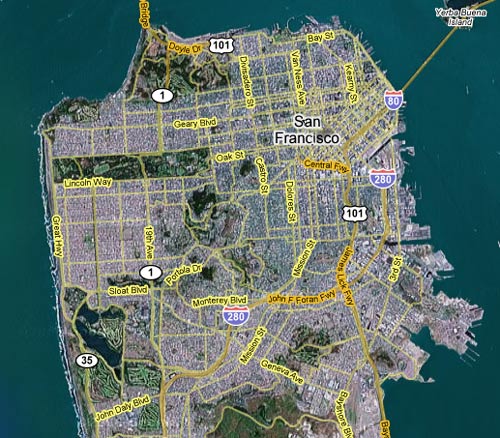
The night before the exhibition I was walking through town. I discovered that a lot of the small wooden houses where public baths, maybe the city had been built by perverted Romans? The streets were full of dirty water and I had to watch my step. Back at the hotel I studied a map of the city and saw it was divided into two districts. The old part of town had the structure of a wagon-wheel. A large church represented the hub of the wheel. The new part of town was called Bergen, had a grid plan structure and was about five or six times as big. A wide river separated the two areas and I came to the conclusion I was looking at a map of San Francisco.
How do we shape our inner cities in our dreams? Picture postcards, memories, atmosphere etc.
/C D


Onboard the plane I read about Icelandic architecture and common Icelandic phrases. I noticed that there were a lot of starving children on the plane, on field-trip or maybe on their way to the exhibition. The children were being entertained by some people skydiving with polar-bears. Town hall in Reykjavik looked a lot like the opera house of Sydney, fronting a large futuristic piazza.
The night before the exhibition I was walking through town. I discovered that a lot of the small wooden houses where public baths, maybe the city had been built by perverted Romans? The streets were full of dirty water and I had to watch my step. Back at the hotel I studied a map of the city and saw it was divided into two districts. The old part of town had the structure of a wagon-wheel. A large church represented the hub of the wheel. The new part of town was called Bergen, had a grid plan structure and was about five or six times as big. A wide river separated the two areas and I came to the conclusion I was looking at a map of San Francisco.
How do we shape our inner cities in our dreams? Picture postcards, memories, atmosphere etc.
/C D


Tuesday, February 9, 2010

Monday, January 11, 2010
On the sea of sound and vision, direction down
This dream displays the Cormorant Council in action, doing some mobilis in mobili dream-geographical thinking/discovery.
Noted dream geographer MF invites a group of people for a tour around the Stockholm archipelago on his yacht. This is all nice, but everybody agrees that we need a specific destination. A woman of the group then invites us all to spend the weekend in her parents´ home in Skåne, should we go there. In order to avoid an embarrassed silence following this more insolent than ridiculous suggestion, I try to joke about it by absurdly agreeing with her. "It´s in the north of Skåne, so it´s really only a few kilometres away from Stockholm." Noone gets the joke, so I begin considering if this absurd geographical assumption is actually true. Instead we enthusiastically decide to go to the Canary Islands.
The navigational chart on board the boat shows the vague outlines of a great sea monster that can be further discerned by connecting some dots on the chart with a blue ink pencil. This is actually how you navigate on this ship. There is no steering-wheel or rudder, just this chart and a pencil to set us going. As I start connecting the dots the sea monster soon appears around us, surprisingly in the form of intensifying sound. As the sound gradually takes the shape of a song or a melody we realize we have arrived at the Canary Islands. Again surprisingly, the Canary Islands are situated beneath us instead of somewhere on the horizontal plane - and to get there we have to climb down a lead line.
The dream to me signals two themes and their possible interrelation.
First, "sound-geography", which could account for synaesthetically percieved journeys or landforms, possibly derived from music or other sonorous structures.
Second, "vertical geography", which could retell hell-visits, rabbit-hole plunging, abyssal exploration and the like.
NN
Noted dream geographer MF invites a group of people for a tour around the Stockholm archipelago on his yacht. This is all nice, but everybody agrees that we need a specific destination. A woman of the group then invites us all to spend the weekend in her parents´ home in Skåne, should we go there. In order to avoid an embarrassed silence following this more insolent than ridiculous suggestion, I try to joke about it by absurdly agreeing with her. "It´s in the north of Skåne, so it´s really only a few kilometres away from Stockholm." Noone gets the joke, so I begin considering if this absurd geographical assumption is actually true. Instead we enthusiastically decide to go to the Canary Islands.
The navigational chart on board the boat shows the vague outlines of a great sea monster that can be further discerned by connecting some dots on the chart with a blue ink pencil. This is actually how you navigate on this ship. There is no steering-wheel or rudder, just this chart and a pencil to set us going. As I start connecting the dots the sea monster soon appears around us, surprisingly in the form of intensifying sound. As the sound gradually takes the shape of a song or a melody we realize we have arrived at the Canary Islands. Again surprisingly, the Canary Islands are situated beneath us instead of somewhere on the horizontal plane - and to get there we have to climb down a lead line.
The dream to me signals two themes and their possible interrelation.
First, "sound-geography", which could account for synaesthetically percieved journeys or landforms, possibly derived from music or other sonorous structures.
Second, "vertical geography", which could retell hell-visits, rabbit-hole plunging, abyssal exploration and the like.
NN
Tuesday, September 29, 2009
Israel = Norway
I look at an old map of Northern Europe from 11 000 B.C. All of Sweden is under water, but Norway is elevated enough to be clearly distinguishable. The name of Norway is, however, "ISRAEL", with the S being a Lambda-sign. We start to speculate: Is Jerusalem in Norway? Is this somekind of Rudbeckian explanation of Scandinavias origin of different golden-age myths (Atlantis, Jerusalem, etc?).
Wednesday, November 14, 2007
DRÖMKARTOGRAFI OCH GÄVLEDRÖMMAR
På förekommen anledning sätter Kormorantrådet under denna rubrik igång sitt materialinsamlande. Vi efterlyser:
1) Exempel på kartor i drömmen och orientering efter karta i drömmen.
2) Drömgeografisk undersökning av Gävle.
3) Försök att använda kartan/kartpunkterna från denna dröm.
4) Synpunkter på materialet och undersökningen.
1) Exempel på kartor i drömmen och orientering efter karta i drömmen.
2) Drömgeografisk undersökning av Gävle.
3) Försök att använda kartan/kartpunkterna från denna dröm.
4) Synpunkter på materialet och undersökningen.
Wednesday, October 31, 2007
Replik från en drömmande 1
Natten efter att man uppmärksammat mig på kormorantrådets blogg drömde
jag följande:
Vaknar på arbetet, där det varit fest och en stor mängd påsar med kaffepulver blivit över. En arbetskamrat har satt igång ett tjugotal kaffebryggare, "Man måste ju passa på". Det droppar in massa folk, inklusive barn, det är någon form av öppet hus. Medan jag väntar på att kaffet ska bli färdigt ber man mig berätta lite om hur man ritar kartor. Jag har ingen aning om vad jag ska säga, men håller en utläggning om komposition av kartbilder, avgränsningar, fokus, nordpil och teckenförklaringar etc (jag påstår att det intressantaste i kartan alltid måste vara strax till höger om mitten i horisontalled och strax under mitten i vertikalled); men jag känner mig obekväm, det kanske inte var detta de menade, kanske är de bara intresserade av Rektifieringens mysterier.
På resa i en minibuss, söderut i trakten av Gävle. Plötsligt stannar bussen och en animerad diskussion tar plats i framsätet över kartboken. Jag begriper inte, det är väl bara att följa E4? Vi promenerar vidare därifrån, passerar genom en stor tunnel, och när vi kommer ut på andra sidan och tittar tillbaka visar det sig att tunneln inte gick genom ett berg utan genom basen av ett enormt träd, som lyser gyllene i solnedgången, lite som en sandstensformation i en nordamerikansk öken, men kanske egentligen bara fullkomligt brunrötat. Därifrån blir det också svårare att följa stigen, som blir allt smalare, våtare och bevuxen med sälg och tall. Snart brer en öppen vattenspegel ut sig framför oss, och i snåren på andra sidan är det väldigt svårt att se någon stig fortsätta. Jag konstaterar "Det här kan inte vara motorvägen", och får till svar "Nej, det är klart, det var ju därför vi stannade bilen, för att hitta en promenadväg". De andra klampar på, och det visar sig att stigen bara är översvämmad, så det är inga problem att vada fram. Men när vi så pulsar genom vattnet i skymningen kan jag plötsligt urskilja massor av människor i brynet mittemot. De står ljudlösa, nästan nakna men kropparna helt målade i grått, beväpnade. Vi hejdar oss. De börjar röra sig mot oss med höjda påkar och spjut, men det är svårt att se i dunklet. Jag föreslår att det kanske är en ritual och vi kan prova att bara gå åt sidan. Men de fortsätter emot oss och siktar på våra huvuden.
MF
jag följande:
Vaknar på arbetet, där det varit fest och en stor mängd påsar med kaffepulver blivit över. En arbetskamrat har satt igång ett tjugotal kaffebryggare, "Man måste ju passa på". Det droppar in massa folk, inklusive barn, det är någon form av öppet hus. Medan jag väntar på att kaffet ska bli färdigt ber man mig berätta lite om hur man ritar kartor. Jag har ingen aning om vad jag ska säga, men håller en utläggning om komposition av kartbilder, avgränsningar, fokus, nordpil och teckenförklaringar etc (jag påstår att det intressantaste i kartan alltid måste vara strax till höger om mitten i horisontalled och strax under mitten i vertikalled); men jag känner mig obekväm, det kanske inte var detta de menade, kanske är de bara intresserade av Rektifieringens mysterier.
På resa i en minibuss, söderut i trakten av Gävle. Plötsligt stannar bussen och en animerad diskussion tar plats i framsätet över kartboken. Jag begriper inte, det är väl bara att följa E4? Vi promenerar vidare därifrån, passerar genom en stor tunnel, och när vi kommer ut på andra sidan och tittar tillbaka visar det sig att tunneln inte gick genom ett berg utan genom basen av ett enormt träd, som lyser gyllene i solnedgången, lite som en sandstensformation i en nordamerikansk öken, men kanske egentligen bara fullkomligt brunrötat. Därifrån blir det också svårare att följa stigen, som blir allt smalare, våtare och bevuxen med sälg och tall. Snart brer en öppen vattenspegel ut sig framför oss, och i snåren på andra sidan är det väldigt svårt att se någon stig fortsätta. Jag konstaterar "Det här kan inte vara motorvägen", och får till svar "Nej, det är klart, det var ju därför vi stannade bilen, för att hitta en promenadväg". De andra klampar på, och det visar sig att stigen bara är översvämmad, så det är inga problem att vada fram. Men när vi så pulsar genom vattnet i skymningen kan jag plötsligt urskilja massor av människor i brynet mittemot. De står ljudlösa, nästan nakna men kropparna helt målade i grått, beväpnade. Vi hejdar oss. De börjar röra sig mot oss med höjda påkar och spjut, men det är svårt att se i dunklet. Jag föreslår att det kanske är en ritual och vi kan prova att bara gå åt sidan. Men de fortsätter emot oss och siktar på våra huvuden.
MF
Subscribe to:
Posts (Atom)